

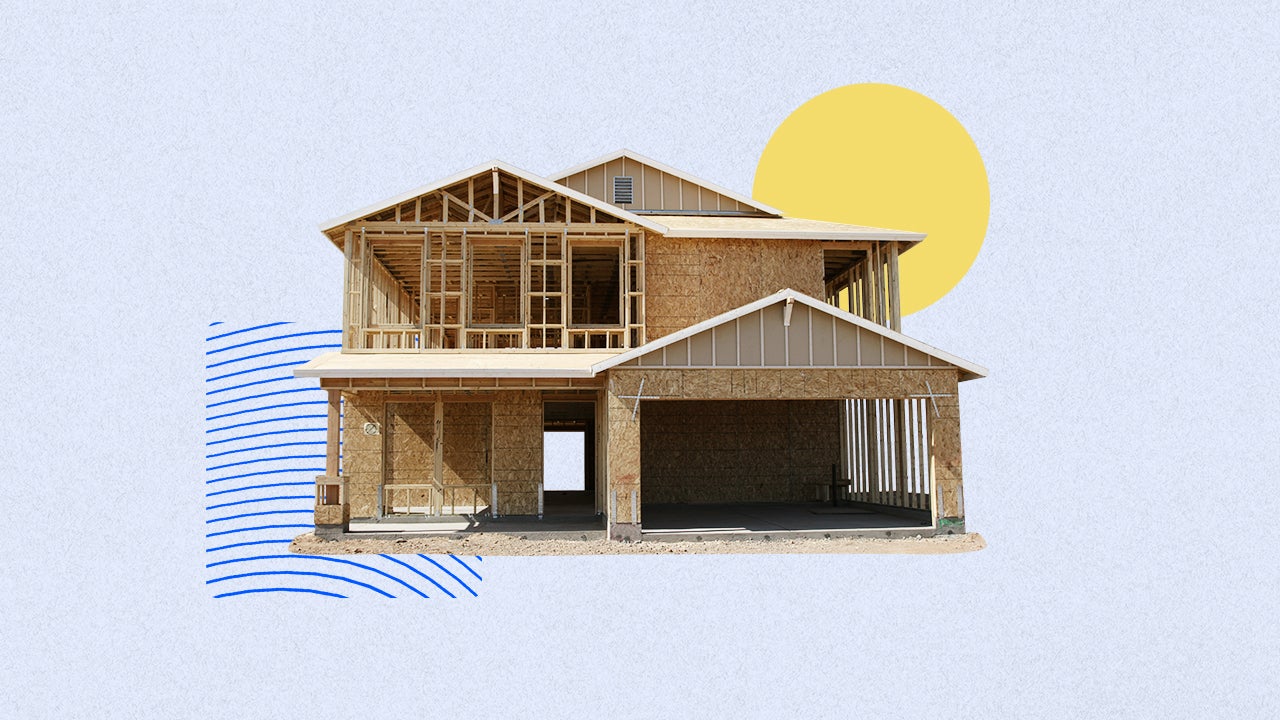
Image by mbogacz/GettyImages/Illustration by Hunter Newton/Bankrate
Key takeaways
- A construction-to-permanent loan finances the construction of a house and converts to a mortgage on completion.
- Construction-to-permanent loans require only one round of closing costs. They also require a down payment.
- With a construction-to-permanent loan, you can draw funds at specific phases of construction, up to a certain loan amount.
What is a construction-to-permanent loan?
A construction-to-permanent loan — also known as a one-time close (OTC) or a single-close loan — is a loan that finances a new-construction home. Once the home is built, the loan converts into a traditional mortgage, usually with a 15- or 30-year term.
A construction-to-permanent loan saves you time and money by streamlining the construction financing and the mortgage. You won’t have to pay two sets of closing costs or close on two separate loans.
How does a construction-to-permanent loan work?
Construction-to-permanent loans function in two phases: construction and post-construction. During the construction phase, the lender authorizes payments, or draws, to cover the cost of land, materials, labor, permits and other expenses. The lender works closely with an inspector to ensure that any work completed matches draw requests.
The construction phase typically lasts about one year, but it can vary depending on your lender, permitting, scheduling and the project’s size. During this time, you might only need to make interest payments. Once construction is completed, the loan converts into a traditional mortgage, and you’ll start repaying the mortgage principal and interest.
Construction-to-permanent vs. construction-only loans
In contrast to construction-to-permanent loans, you could choose a construction-only loan. These loans also cover costs related to land, labor, materials and permits, but they don’t convert into a mortgage once the home is complete. Instead, you’ll shop for a new mortgage and repay the construction loan, either with cash or your mortgage funds. You’ll pay two sets of closing costs.
You might choose the construction-only route if you plan to sell the home after building or if your preferred construction lender doesn’t offer a conversion option.
Construction-to-permanent loan example
Imagine you decide to build a new home. You want to purchase a parcel of land that costs $50,000, and you estimate that the house will cost $350,000 to build. In total, you would need $400,000 of financing.
Construction-to-permanent loans typically require a 20 percent down payment, which would be $80,000 in this case, and leave you with a $320,000 loan. To borrow $320,000 over a 30-year period with a 7 percent interest rate, your monthly principal and interest payment would be about $2,129. However, you might be able to pay only interest during the construction phase.
Construction-to-permanent loan eligibility requirements
Since there’s substantial risk involved with building a home, lenders typically have more stringent requirements for construction-to-permanent loans. Conventional construction-to-permanent loans can have fewer restrictions than government-backed loans, however. Here are the typical requirements:
- Down payment: 20 percent (but could be as low as 5%)
- Credit score: 680
- Debt-to-income (DTI) ratio: 45 percent or below
- An estimated appraisal: An appraiser will need to determine the home’s estimated completed value.
- Project approval: The lender needs to approve your budgets, schedule, blueprints and more.
- Architect and contractor approval: You’ll need to hire licensed, professional builders and submit copies of their licenses, certificates and/or resumes to your lender.
Pros and cons of construction-to-permanent loans
Construction-to-permanent loans have benefits as well as drawbacks. Here are the major ones to consider.
Pros
- Single approval process: Qualify once instead of twice, saving time and reducing uncertainty.
- One closing: Combines construction loan and mortgage, reducing closing costs.
- Draw funds as needed: Construction-to-permanent loans pay out to builders as the project progresses.
- Interest-only payments during construction: Many construction-to-permanent loans require only interest payments during construction.
Cons
- Larger down payment: Lenders may require more upfront since the home isn’t built yet.
- Risk of cost overruns: If building expenses exceed the loan amount (which is common), you’ll be required to cover the difference.
- Higher interest rates: Rates may be higher than traditional mortgages, especially during the construction period.
- Stricter requirements and deadlines: Detailed plans, approved builders and firm construction timelines are required.
How to apply for a construction-to-permanent loan
Many lenders offer construction-to-permanent loans, but you’ll most often find them at a bank or with a lender specializing in construction financing. Applying involves more steps than applying for a standard mortgage.
Here’s what you’ll need to do to get started:
- Get preapproved: Like with other types of mortgages, it’s a good idea to get preapproved for a construction-to-permanent loan. Getting preapproved will tell you how much funding you can get based on factors like your credit score and DTI ratio.
- Find a builder and an architect: Research potential builders and architects, read up on their reputations and ask for references. Then set a budget and a timeline and finalize the home’s design.
- Get a lender: Consider at least three offers from different lenders, comparing their rates and their experience funding construction-to-permanent loans. Read consumer reviews of each lender as well. Once you decide on one, you’ll need to apply for the loan, submitting paperwork on income, assets, debts and more.
- Buy insurance: Your lender may require you to buy builder’s risk insurance or new construction insurance to cover the home while it’s being built.
Frequently asked questions
Why we ask for feedback
Your feedback helps us improve our content and services. It takes less than a minute to
complete.
Your responses are anonymous and will only be used for improving our website.
Help us improve our content
Read the full article here